AI Driven Work Order Time Insights
Asset Essentials Enterprise features the Work Order Time Estimate, an AI-powered projection of the hours that will be needed to complete a work order. This estimate leverages advanced machine learning to analyze work order characteristics – such as type, priority, historical completion data among others – to deliver tailored time predictions.
Key Benefits:
Optimized Resource Planning: Enables supervisors to allocate labour and resources based on AI-driven projections, reducing overtime and cost overruns.
Data-Driven Decision Making: Identifies variances between projected and actual hours, helping pinpoint inefficiencies and areas for process improvement.
Continuous Improvement: As your organization logs more historical work order data, the AI model continuously learns and delivers increasingly accurate estimates—empowering you to enhance maintenance performance over time.
Explore the Work Order Time Estimate on the Maintenance Insights dashboard.
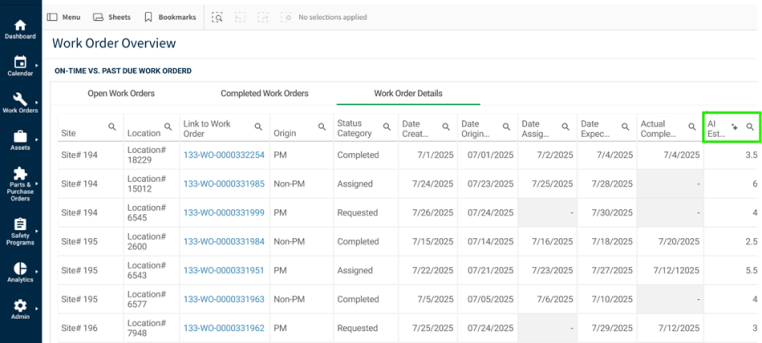
You can find the AI predicted estimate for work orders in the Work Order Details table, along with a measure of the variance between the estimate and the actual hours logged on the work orders.
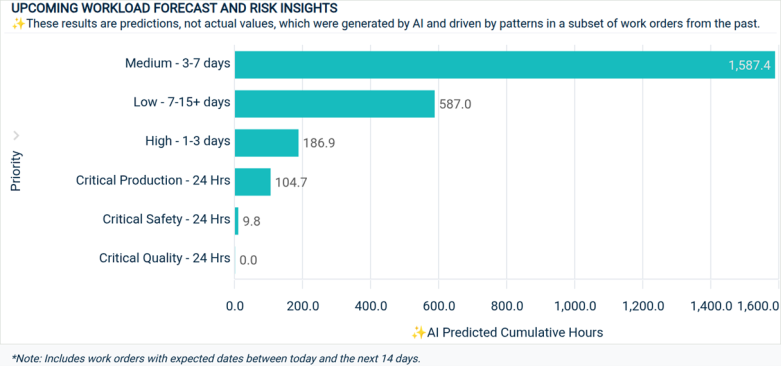
Beneath and to the left of the Work Order Details table, an interactive chart provides an aggregated view of the Work Order Time Estimate values (or AI Predicted Cumulative Hours) by various dimensions. The chart includes new and open work orders with expected completion dates in the next two weeks. The toggle on the left side of the chart allows you to switch between two dimensions, Priority and Expected Completion Date.
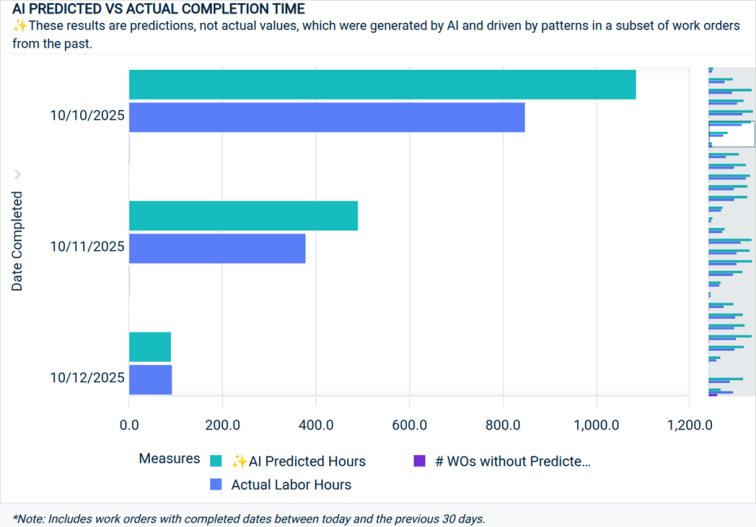
Additionally, the chart below shows how the predicted hours compare to the actual hours logged on completed work orders, aggregated by Date Completed or by Priority. This helps track prediction accuracy over time.
Tip: High-quality, complete work order data drives better predictions. Gaps between expected and actual hours can help you identify opportunities to improve your data collection practices and operational workflows.